There’s an old Tswana description of time that might make you think a little differently about the moon next time you look at it: each day ends with a crocodile eating the sun and excreting the moon. It’s an image that has pressed on Boemo Diale’s mind for quite some time. So what does she see when she looks up at the night sky?
“I wrote a little story about the passing of time in relation to Tswana cosmology and other indigenous cosmologies,” she says. “I also looked at maternal knowledge.”

The result of that story — along with a lot of painting and the making of ceramic vessels — is a new exhibition titled So Quick the Crocodile Has Eaten the Sun, opening on October 10 at Kumalo | Turpin gallery in Parktown North.
“I realised that I could start pulling threads from my life, artistically, and create stories.”
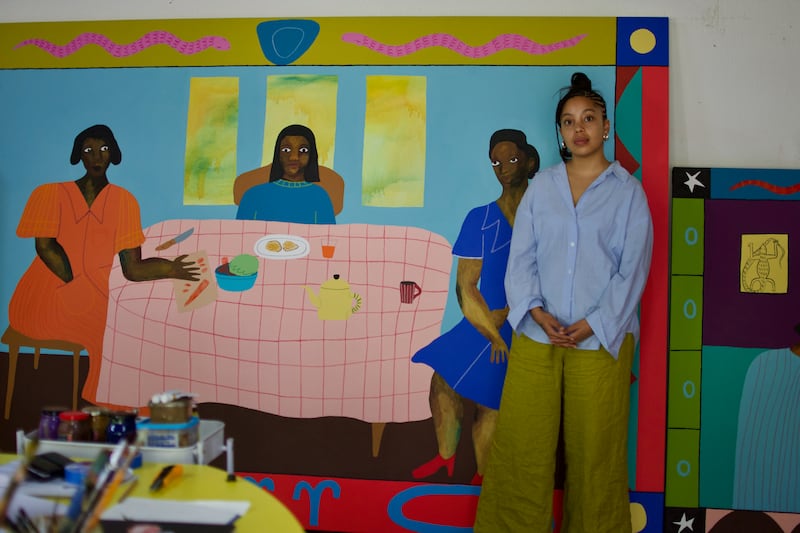
I met Diale at her studio in Bramley. It’s everything you’d expect an artist’s space to be. Natural light floods in from the garden and there’s the smell of paint and turpentine. In the middle of the room is a long table cluttered with jars of brushes and pencils, and sketches in various stages of completion. Nearby is a brown leather couch spattered with paint. The exposed roof trusses make you think you’re inside a whale’s stomach. But the centrepieces, of course, are the large canvases leaning against the walls, pulsing with colour.

The paintings are populated by the things that have long appeared in Diale’s work: women, bodies, vessels, symbols and the strange interior worlds we form in childhood, where memory, imagination and experience become difficult to separate. But something has moved. The new work feels less concerned with explaining Diale herself than with exploring time and the ways we build a world around ourselves.
Birth of a new world
At the centre of that world are three women. The largest work in the studio, The Maternal Table, depicts a girlish Diale seated at a table, flanked by her mother and grandmother. On the table are a chopping board with slices of carrot, a teapot, a plate and a glass of juice. Behind her are three rectangular windows — another thread connecting the works.
Diale has spoken frequently about the influence of both women, particularly her grandmother, whose home in Rustenburg was a constant throughout her childhood. That’s where those three windows come from: Diale vividly recalls sitting in her grandmother’s kitchen, marvelling at the light spilling through them and filling the room. Sunlight and moonlight both.

But in these new works, Diale’s expressions are less about her own experience of the maternal and more about maternality in a broader sense. She became interested in an idea she encountered in Taoist cosmology, in which something at the very beginning was pregnant with possibility and gave birth to time and existence.
“I was thinking about the maternal, as in this womb,” she says. “Not about actual pregnancy, but the birth of a new world.”
This idea of creating, containing and protecting runs throughout the work. Just as a womb encloses the unborn, borders surround some of Diale’s paintings. And, as a rule, the paintings without a border contain a vessel. The borders are filled with symbols drawn from different traditions, including Ghanaian Adinkra symbols, but they also serve a deeper, more ritualistic purpose.

“The border is like a protection spell,” she says, “closing in and protecting whatever this dreamlike reality is that I’m creating.”
We go quiet for a moment. The high roof of the studio ticks under the springtime sun. In the garden, weavers are going berserk, building their own grassy containers before it’s too late.
Some of those dreamlike realities come from memory. Others, she says, are envisioned.
Another work shows her again as a young girl, a Bible and candle perched on a shelf behind her. The scene draws on her Christian upbringing, but the objects also point to something broader: the tools and talismans we use to protect ourselves, “whether you believe in something or not”.

The vessel has become equally important. Diale is interested in its ordinary function, as something made to carry or contain, but also in the spiritual history of the object. Clay can be transformed into something useful or beautiful, but vessels have also been used in rituals.
“In a lot of indigenous and old African practices, they’d create vessels and break them to call upon things, bury or seal them,” she says. “It’s my made-up religion, this practice. I create my own meaning with things.”
The mystery waving back
Diale, 26, grew up moving between Joburg and Rustenburg, between the suburbs and her grandmother’s home. As a young girl, watching the landscape change from the back seat of the car, she noticed how different those worlds were, and began to understand the inequalities of post-apartheid South Africa.
At her grandmother’s, she’d sit at a table and draw and paint — a practice she returns to today — a way of tapping into the simplicity of early memories: red soil, tea, thick slices of buttered bread.
Later, attending a Model C school in Joburg produced another set of contrasts. “That brought up a lot of questions for me, sociopolitically in the context of what it means to be a black South African woman in a post-apartheid landscape,” she says. “What was going on? Why did some people have access to things while others didn’t?”
As a teenager, Diale began going to art fairs. “I was emo,” she says. “Until then, being an artist hadn’t presented itself as a possible life. What? I can spend all day painting and listening to music, and get paid for it?”
“I realised that I could start pulling threads from my life, artistically, and create stories.”
Those threads have included race, mental health, family, spirituality and childhood. Her earlier work turned towards her identity and family history. In Going Home, which won the Tomorrows/Today Prize at the 2024 Cape Town Art Fair, ideas of home, prayer, her grandmother and mental health were central.
Her newer works push those concerns outward. Folklore and cosmology are woven into family history. Christianity holds hands with indigenous ritual. Inherited symbols and talismans intermingle with a connection to the divine that Diale has invented herself. Research and intuition occupy equal realms.
“A lot of my spirituality is anchored in archive,” she says. “I have a spiritual reflection and response to what I read about.”
Sometimes, in the best moments, the artist’s process crosses over from rational, structured thought into something that feels like magic.
“When I’m working I experience a literal download,” she says. “It pops up in my head, I don’t know where it comes from. In that flow state I open a channel to receive those messages.”

Hope as radical
Diale works best in summer. The studio is warm, she can go barefoot, and there’s always the promise of a Highveld thunderstorm to bring in the memory of lightning and petrichor, thunder rolling through the body. Music goes on as soon as she enters it, and continues for the day. When things are going well, she breaks into dance. Picture it: arms and legs moving to a rhythm that extends to the brush in her hand, the strokes on the canvas.
“A day in the studio starts in a rise and then a fall,” she says. “I begin with upbeat music. Towards the middle of the day the music is slower and more connected — at the peak, I might listen to Thandi Ntuli, speaking about the cosmos.”
Diale says she thinks in colour before she thinks in images. Her current obsession: pink. There’s something useful in that instinct. For the references to cosmology, ritual, family history and inherited knowledge, the paintings aren’t burdened by their ideas. They remain bright, bodily and strange. Earlier work dealt with generational trauma, identity and mental health, but Diale has consistently used colour and playfulness against the weight of those subjects.
This new work expresses hope. “Maternality as hopefulness,” she says. “Especially in the world we live in where it’s radical to have hope.”
Maybe that’s what the vessels and borders are doing — holding something long enough for another possibility to emerge.
Diale has been working as a full-time artist since she was 24. What that life has given her, she says, is control over her own time. There’s an echo of the freedom she allows herself inside the work: to borrow, invent, remember, distort and combine.
“I don’t believe in limited thinking,” she says. “You can make it up as you go along. There aren’t any rules.”
Somewhere inside that invented world, the crocodile keeps eating the sun.
- So Quick the Crocodile Has Eaten the Sun runs from October 10 to October 31 at Kumalo | Turpin gallery, Nine Yards, Yard 7, 167 Jan Smuts Avenue, Parktown North, Johannesburg. Visit kumaloturpin.com




Would you like to comment on this article?
Sign up (it's quick and free) or sign in now.
Please read our Comment Policy before commenting.